


Free higher education was envisioned as a transformative instrument for poor and historically marginalised South African youth. It emerged from decades of struggle and was forcefully articulated during the #FeesMustFall movement, when students demanded an end to financial exclusion from higher education. That demand carried moral weight and national urgency. Yet today, the National Student Financial Aid Scheme (NSFAS), the institution charged with advancing this vision, has increasingly come to symbolise its erosion.
NSFAS did not create the idea of free higher education; it inherited it. The policy was born out of student activism and public pressure, not bureaucratic foresight. However, rather than becoming a reliable custodian of this hard‑won victory, NSFAS has, over time, become one of its weakest links.
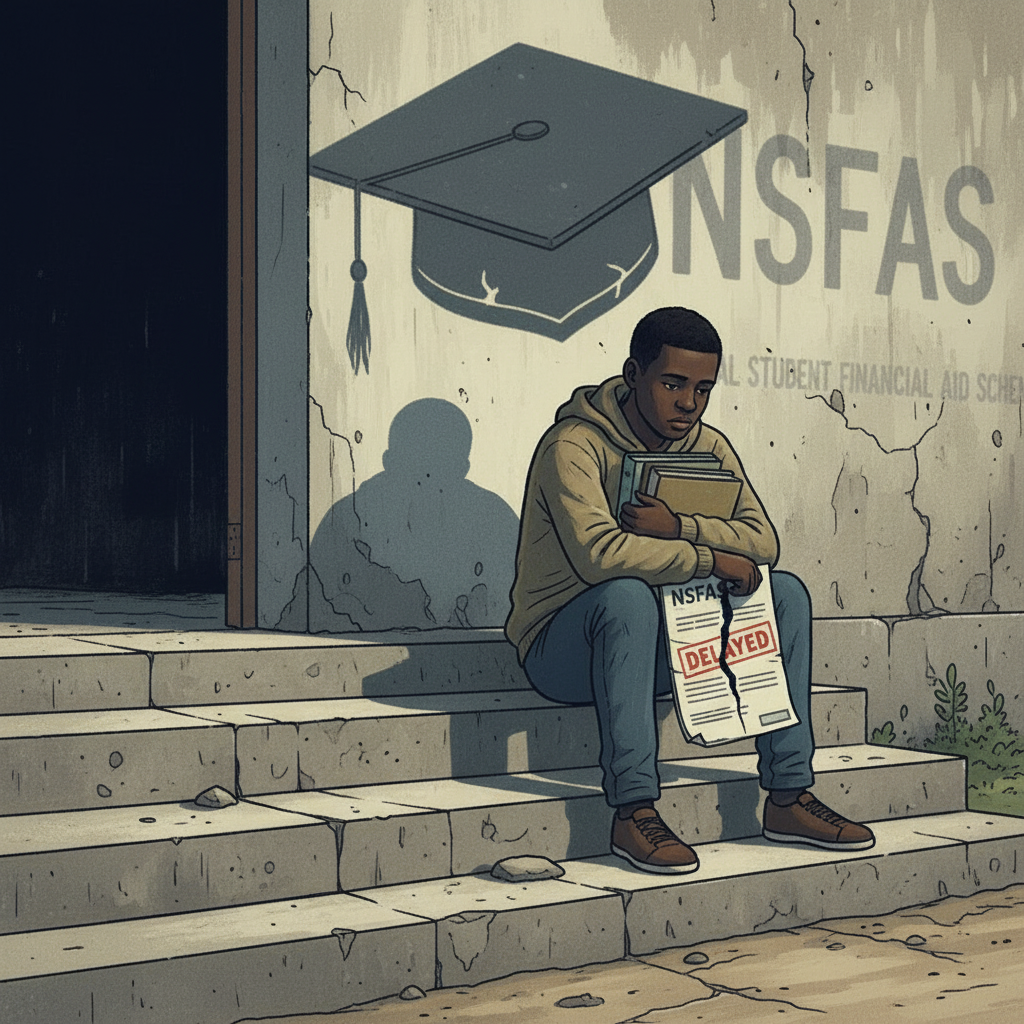
Year after year, the scheme is plagued by crises that are no longer exceptional but routine. Delayed or unpaid allowances, unsettled tuition fees, accommodation bottlenecks, and administrative breakdowns have become defining features of the NSFAS system. These failures have tangible consequences. Students go hungry, face eviction from residences, experience academic disruption, and endure mounting psychological stress. For many, the promise of liberation through education has been replaced by a daily struggle for survival—a dream deferred.
These are not isolated “teething problems” or minor logistical snags, as they are often described. They reflect deeper, systemic weaknesses: administrative incompetence, unstable leadership, poor governance, and an alarming lack of accountability. The consequences of these failures are well documented through parliamentary inquiries, court cases, and investigative journalism.
A significant turning point in the deterioration of the system was the centralisation of NSFAS administration away from universities. While universities were far from perfect, they possessed institutional experience, operational capacity, and proximity to students. Removing NSFAS functions from these institutions was presented as a technical reform, but it was ultimately a political decision with far‑reaching consequences. Centralisation weakened oversight, disrupted established support systems, and created fertile ground for political interference and private capture.
Today, private intermediaries and venture‑driven companies occupy a central role in a scheme meant to serve the poor. Critical functions—such as off‑campus accommodation accreditation—have been outsourced to profit‑oriented entities. The result has been inflated costs, questionable standards, and widespread exploitation. Instead of strengthening public institutions, the system has commodified poverty. Poor students, particularly black students, have effectively become units in a market structured around their desperation.
This model reflects a broader contradiction in South Africa’s post‑apartheid political economy. State funds intended for social transformation increasingly flow through privatised channels, benefiting a narrow set of intermediaries while failing the intended beneficiaries. In this context, NSFAS has become a site where public purpose is subordinated to private gain.
The persistent failures of NSFAS cannot be separated from the political choices that shaped it. Weak oversight, tolerance of maladministration, and the absence of meaningful consequences for failure point to a broader ethical and governance crisis. As political uncertainty grows, the risk of entrenched patronage and corruption deepens, particularly in institutions responsible for redistributive justice.
The failure of NSFAS is not merely administrative; it is symbolic. It reflects the broader inability of the state to translate progressive policy commitments into lived reality for the poor. Instead of breaking cycles of poverty, the system increasingly reproduces them.
Free education cannot be realised through privatisation, fragmented accountability, or governance models that prioritise profit over people. If decisive intervention does not occur, NSFAS will continue to undermine the very social justice principles it was meant to uphold, extending the suffering of students and narrowing the promise of transformation.
The future of South Africa’s youth cannot be treated as a transactional opportunity. It demands courage, ethical leadership, and a recommitment to education as a public good—not a marketplace. Without this, NSFAS risks becoming another cautionary chapter in the country’s unfinished struggle for genuine free education, economic transformation and social justice.
Dr Seroko Ramoshaba is a higher education practitioner and academic with over 30 years’ experience, including senior leadership roles at several South African universities. He holds a PhD in Public Management and Development and is a published scholar and advocate for social justice, transformation, and community‑engaged education


