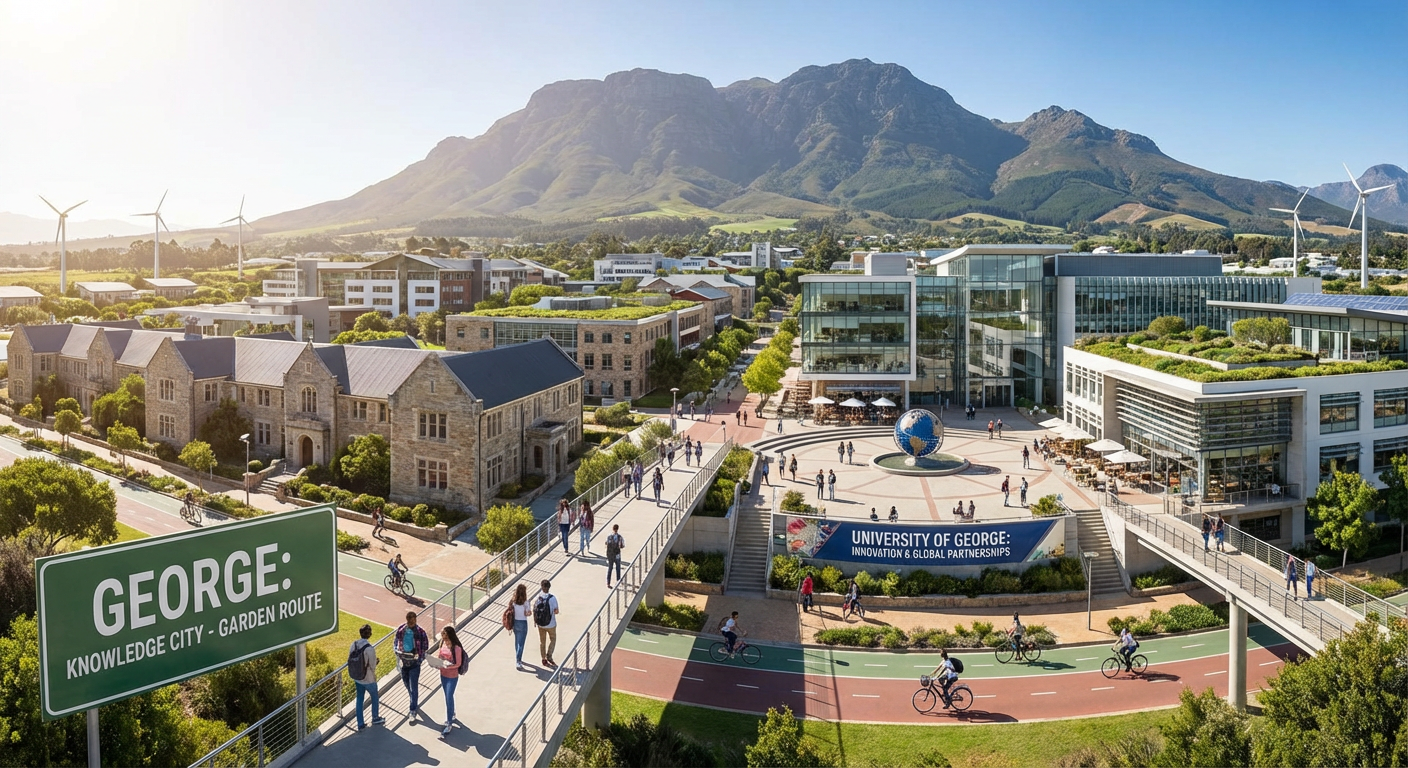
George has long been known as the gateway to the Garden Route — a place of natural beauty, innovation, and opportunity. Yet the time has come to embrace a more ambitious vision: transforming George into a vibrant knowledge city where education, innovation, culture, and community thrive in unison.
Across the globe, some of the most dynamic and prosperous cities are university towns — places where higher education institutions, local government, industry, and communities collaborate to build ecosystems of learning, creativity, and economic growth. Cities such as Oxford, Cambridge, Leuven, and Champaign-Urbana demonstrate that when universities become central to a city’s development strategy, extraordinary outcomes follow. These cities attract global talent, stimulate entrepreneurship, foster cultural vibrancy, and drive sustainable economic development.
George possesses all the ingredients required to join this global network of leading university towns.
Its strategic geographic positioning places it at the heart of the Garden Route — one of Africa’s most attractive and sought-after regions. Its natural environment, quality of life, and accessibility make it uniquely appealing to students, academics, and researchers from across South Africa and beyond.
At the same time, George’s growing higher education capacity positions it as an emerging academic hub. With deliberate collaboration and strategic expansion, the city can cultivate specialised programmes in environmental sciences, tourism management, renewable energy, marine studies, digital technologies, and entrepreneurship — fields that align closely with regional strengths and global demand.
There is also a clear and growing commitment to innovation and partnership. A world-class university town is not built by universities alone. It requires strong, integrated collaboration between the municipality, higher education institutions, industry, civil society, and the private sector. The municipality’s role is to create an enabling environment through forward-looking infrastructure, student-friendly urban planning, safe and efficient transport systems, reliable digital connectivity, and vibrant public spaces that extend learning beyond the classroom.
The future vision for George must therefore be bold and intentional. It must be a knowledge-driven city where research, innovation, and entrepreneurship fuel economic growth. It must be a student-centred city where young people from across Africa feel welcome, safe, and inspired. It must be a globally connected academic hub, attracting partnerships with leading universities and research institutions worldwide. And it must be a city of integrated learning, where education is embedded within the cultural, social, and economic fabric of everyday life.
To realise this vision, several strategic initiatives are essential. Foremost is the development of the George Academic City concept — a collaborative platform uniting universities, research centres, innovation hubs, and student support systems into a cohesive knowledge ecosystem.
Equally important is the expansion of student accommodation and the creation of student-friendly urban spaces, ensuring that George evolves into a city designed not only for residents but also for scholars, innovators, and young professionals.
The establishment of innovation districts and industry-linked research partnerships will be critical, particularly in sectors where the region holds a competitive advantage — including tourism, green energy, agriculture, climate resilience, and the digital economy.
Internationalisation must also form a cornerstone of the strategy. George should position itself as a destination for international students, academic exchange programmes, and cross-border research collaboration across Africa and beyond.
Finally, the benefits of this transformation must be inclusive. A thriving university town creates jobs, stimulates small and medium enterprises, enriches cultural life, and opens pathways of opportunity for local youth and surrounding communities.
This vision is not merely about expanding campuses. It is about building a city of ideas, opportunity, and global relevance.
If realised, George will become far more than a scenic destination along the Garden Route. It will emerge as a leading African university town — a place where future leaders come to learn, innovate, and shape the continent’s trajectory.
The call to action is clear: universities, government, industry, and citizens must work together to turn this vision into reality.