

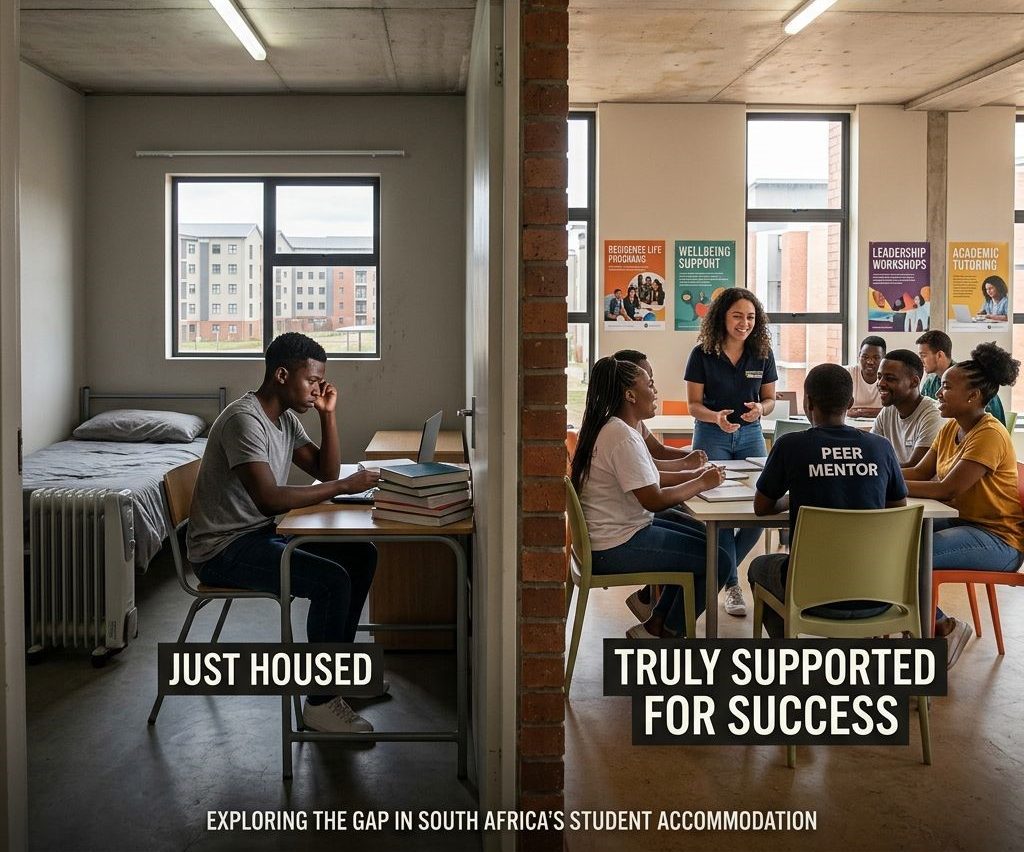
As South Africa continues to expand access to higher education, a pressing question is emerging across campuses and in policy circles: are students receiving more than just a bed to sleep in?
The rapid growth of private student accommodation, largely funded through the National Student Financial Aid Scheme (NSFAS), has helped address the country’s chronic housing shortage. Yet growing concerns suggest that while access to accommodation has improved, the quality of developmental support within these spaces remains uneven. The issue is no longer simply about shelter; it is about whether accommodation meaningfully contributes to student success.
The Department of Higher Education and Training’s Norms and Standards for student accommodation are explicit. They envision environments that are not only safe and functional but also conducive to learning, well-being, and holistic development. However, the lived reality across institutions reveals a troubling gap between compliance and experience.
Consistent evidence from institutions shows that students in university-managed residences tend to perform slightly better academically than their peers in private accommodation. The explanation extends beyond proximity to lecture halls. On-campus residences are embedded within structured “residence life” programmes that include peer mentoring, tutoring, leadership development, and social integration initiatives. These programmes are intentionally designed to cultivate a sense of belonging, academic discipline, and graduate attributes such as critical thinking and civic responsibility.
By contrast, many NSFAS-accredited private accommodations operate primarily as housing providers rather than educational partners. While some offer modern facilities and reliable services, others fall short in providing adequate study spaces, stable internet connectivity, and quiet learning environments. More importantly, they often lack structured developmental programming that integrates students into a broader academic support system.
The accreditation process itself has tended to prioritise infrastructure, beds, bathrooms, and security over the quality of student life within these spaces. Reports of overcrowding, inconsistent maintenance, and safety concerns continue to surface in parts of the private accommodation sector. Compliance with minimum standards does not necessarily translate into a supportive student experience.
Staffing further illustrates this divide. University residences are typically managed by trained student affairs professionals who understand student development theory, mental health support, and community building. Their presence is not incidental; it is central to shaping environments where students can thrive. In contrast, many private accommodation providers rely on property management personnel whose expertise lies in operations rather than student development. Efficient management does not automatically equate to holistic support. The result is a system where students are housed, but not always supported.
International models offer instructive lessons. France’s CNOUS system, a state-coordinated network of student services, integrates accommodation directly with welfare, academic support, affordable dining, health services, and cultural programming. Student housing is not treated as a stand-alone commercial service but as a core pillar of the national student success framework. Staff are trained as student development practitioners, and strong state oversight ensures consistent quality across regions. Accommodation in this model is a developmental intervention, not merely a logistical arrangement.
South Africa’s experience stands in contrast. While NSFAS has succeeded in expanding access to accommodation at scale, housing has not yet been fully integrated into a coherent student success strategy. This has produced what analysts describe as a developmental gap, the difference between providing infrastructure and cultivating environments that actively promote learning, wellbeing, and personal growth.
The higher education system now stands at a crossroads. The expansion of NSFAS-funded accommodation has undoubtedly widened access. Yet without stronger coordination, staff professionalisation, integrated service delivery, and rigorous oversight, these gains risk being undermined. Students from disadvantaged backgrounds, who depend most on state-funded accommodation, are also those most vulnerable to systemic weaknesses.
The way forward lies in reimagining student accommodation as part of a broader student ecosystem, one that brings together universities, private providers, and government within a coordinated framework. Such a model would ensure that all accommodation, whether public or private, includes structured residence life programmes, development-oriented staff, integrated academic and psychosocial support, and clear accountability mechanisms.
Private accommodation undoubtedly plays a role in South Africa’s higher education landscape. The real challenge is ensuring that these spaces contribute meaningfully to student success and justify the significant public investment they receive.
South Africa has made undeniable progress in funding access to higher education. The next frontier is ensuring that access leads to success. For thousands of students across the country, that distinction may determine not only their academic outcomes, but their futures.


