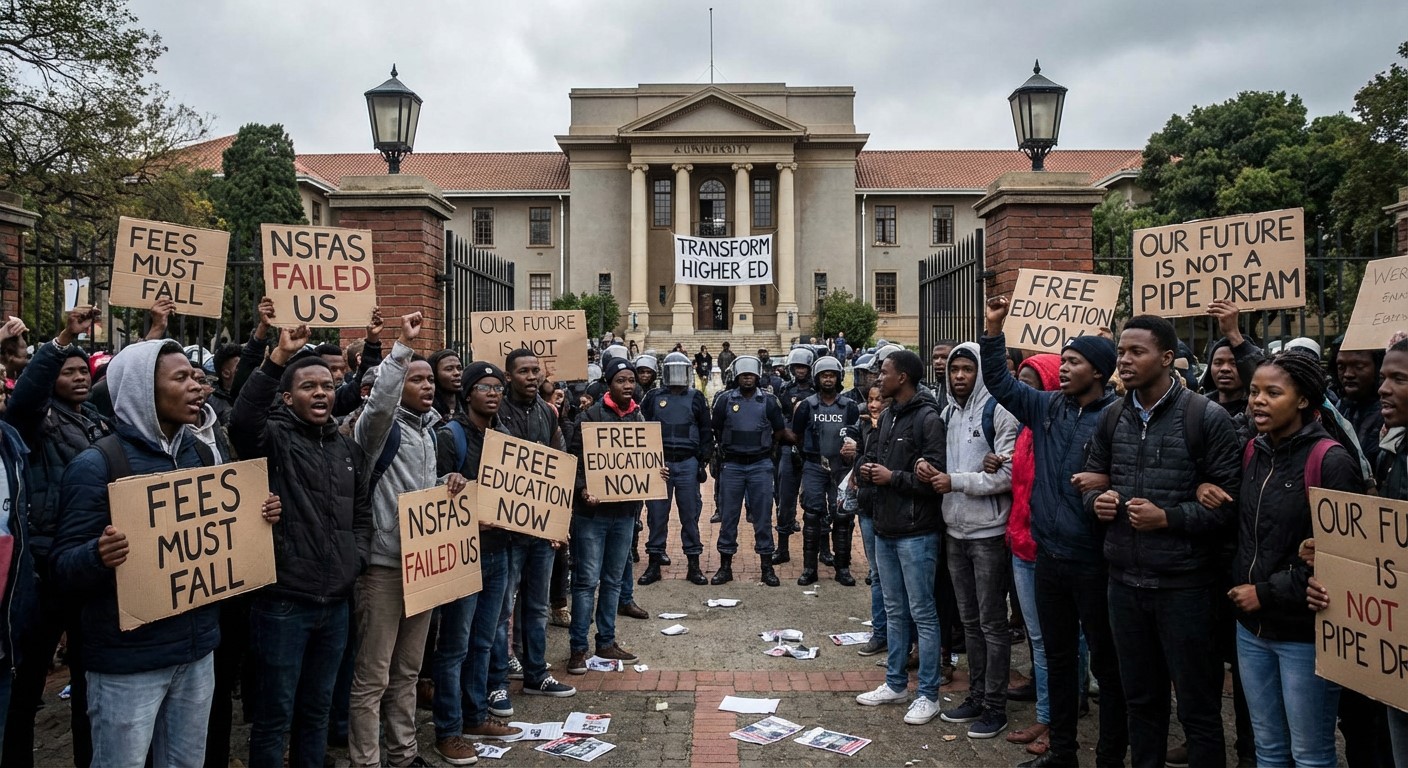
The current student protests during the State of the Nation Address by President Cyril Ramaphosa, at Wits University and other institutions, are symptoms of the systematic exclusion of students from poor families. African National Congress-led governance promised a new era, one that would transform the lives of all and sundry, both the former oppressors of apartheid and the formerly oppressed South Africans.
The promise of free education, as espoused in the Freedom Charter, has become a dream deferred for the youth. The right to a transformed higher education system, anchored in academic excellence and social mobility for poor students, now appears to be a pipe dream. Thirty years into democracy, South Africa displays a dysfunctional higher education funding system. Financial and academic exclusion remain the lived and learned realities of poor and working-class students.
The failure of NSFAS to provide truly free and accessible higher education has become a central source of instability in South African universities. Instead of reducing inequality, NSFAS has, in many respects, reproduced and deepened inequalities within higher education for students from low-income households. Administrative crises, delayed payments, and governance failures have destabilised institutions and disrupted academic life.
The failure of the ANC-led government does not lie merely in the absence of funding models. Rather, it is rooted in the absence of a coherent educational developmental vision within the higher education sector. The issue is not only technical, but it is also political and imaginative.
South Africa urgently needs a transformative higher education agenda, one that addresses historical student debt, the massification of university admissions without adequate support, access without success, and success without sustainability. The sector continues to suffer from structural and unsustainable funding models, weakened institutional capacity, and insufficient formal support programmes for first-generation students.
At the centre of this crisis lies a lack of accountability within NSFAS governance structures, intertwined with cronyism and political patronage. Without transparent and ethical leadership, policy implementation becomes hollow and unstable.
The ANC-led government often positions itself as the saviour of poor Black children, the historical victims of apartheid. Yet students from previously disadvantaged communities must not be cast merely as recipients of state benevolence. They must be recognised as agents of their own transformation. They must be provided with space to exercise their agency and become future leaders, entrepreneurs, scientists, doctors, innovators, researchers, economists, and global knowledge producers.
They must not be survivors of poverty rescued by the state; they must be drivers of social justice and socio-economic transformation. However, current governance patterns risk shaping poor youth into passive heirs of ANC-led state benevolence rather than active co-creators of nation-building.
The crisis in higher education is not fundamentally about money. It is about the failure of political imagination, weak governance, poor accountability, and the inability to recognise young people as co-creators of South Africa’s future.