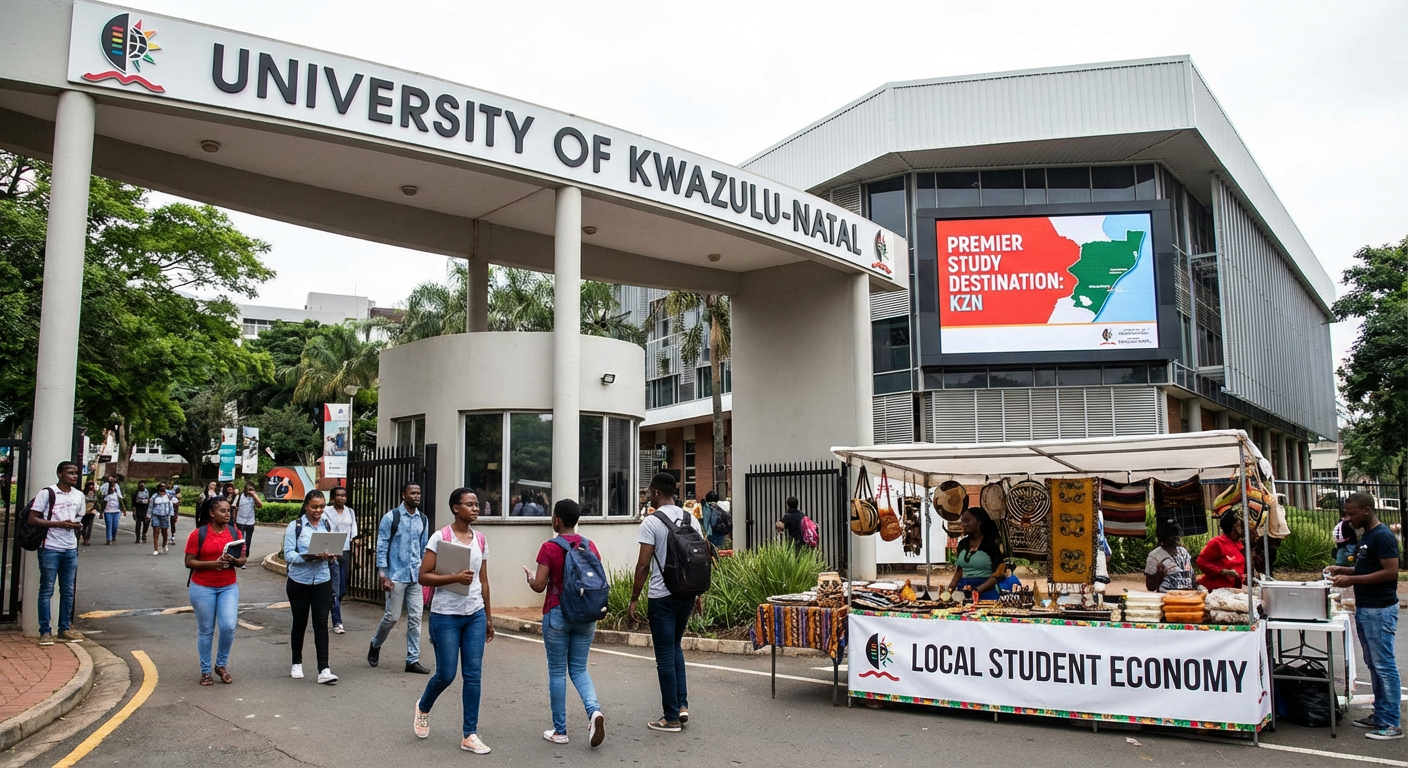
In South Africa’s rapidly shifting higher education and urban development landscape, universities are no longer merely centres of teaching and research; they are powerful engines of economic growth, spatial transformation, and social change. Few institutions embody this evolution more convincingly than the University of KwaZulu-Natal, UKZN.
Positioned across the vibrant coastal metropolis of Durban and the historic inland capital of Pietermaritzburg, UKZN is uniquely placed to drive what is increasingly recognised as South Africa’s student economy, a dynamic and fast-growing ecosystem reshaping cities and regions.
Globally, the concept of an anchor university has gained traction. These institutions are deeply embedded in their local economies, acting as stabilising forces and catalysts for long-term development. UKZN fits this profile seamlessly. Its campuses are not isolated academic enclaves; they are economic nodes influencing property markets, transport systems, small business development, and even urban planning decisions. Every lecture hall, residence, and research facility feeds into a broader ecosystem of opportunity.
Perhaps the most underappreciated driver of this impact is the student population itself, which now exceeds 50,000. Across Durban and Pietermaritzburg, thousands of students generate daily demand for housing, food, transport, connectivity, and lifestyle services, sustaining informal traders and township enterprises, the local retail and hospitality sectors, private student accommodation providers, and public and minibus transport networks. Students are not merely learners; they are active economic participants whose spending power shapes neighbourhoods and livelihoods. Yet much of this economy remains fragmented and under-optimised, and without coordinated planning, its full developmental potential remains untapped.
KwaZulu-Natal’s eastern coastal belt offers a compelling value proposition that few regions in South Africa can match. Durban combines a subtropical climate, world-class beaches, and a rich cultural tapestry with the infrastructure of a major port city. For students, particularly those from across the SADC region, this translates into an attractive blend of academic opportunity and quality of life. Pietermaritzburg offers a complementary environment, quieter, historically rich, and conducive to focused academic engagement. Together, these cities form a multi-nodal study destination anchored by UKZN’s academic excellence and research reputation.
Despite these advantages, a critical gap remains: the absence of fully integrated campus precincts. Around the world, leading university cities such as Boston and Melbourne have demonstrated that when campuses are intentionally integrated with their surrounding urban environments, they unlock safer, more walkable student communities, higher-quality accommodation and infrastructure, increased private-sector investment, and stronger innovation and startup ecosystems.
For UKZN, this calls for moving beyond ad hoc development towards a structured Campus Precinct Development Framework, one that aligns university growth with municipal planning led by entities such as the eThekwini Metropolitan Municipality and Msunduzi Local Municipality. Such a framework would enhance the student experience while catalysing inclusive economic development in surrounding communities.
The greater opportunity lies in reimagining Durban and Pietermaritzburg as true student cities, places where students’ needs, aspirations, and economic contributions are intentionally integrated into urban policy and planning. This vision encompasses affordable, purpose-built student accommodation, efficient and safe public transport systems, vibrant mixed-use precincts with retail, recreation, and learning spaces, innovation hubs that connect students to industry, and strong partnerships among universities, municipalities, and the private sector.
If executed with clarity and commitment, this approach could position KwaZulu-Natal not merely as a provincial education hub but as a continental leader in student-centred urban development.
The University of KwaZulu-Natal possesses both the scale and strategic positioning to lead this transformation, yet it cannot do so alone. A deliberate and coordinated effort involving government, investors, planners, and communities is required to unlock the full value of the student economy.
The question is no longer whether UKZN can act as an anchor institution; it already does. The real question is whether KwaZulu-Natal is prepared to fully embrace and leverage this reality to position itself as a premier study destination along South Africa’s eastern coastal belt.
The opportunity is clear, and the time to act is now.