

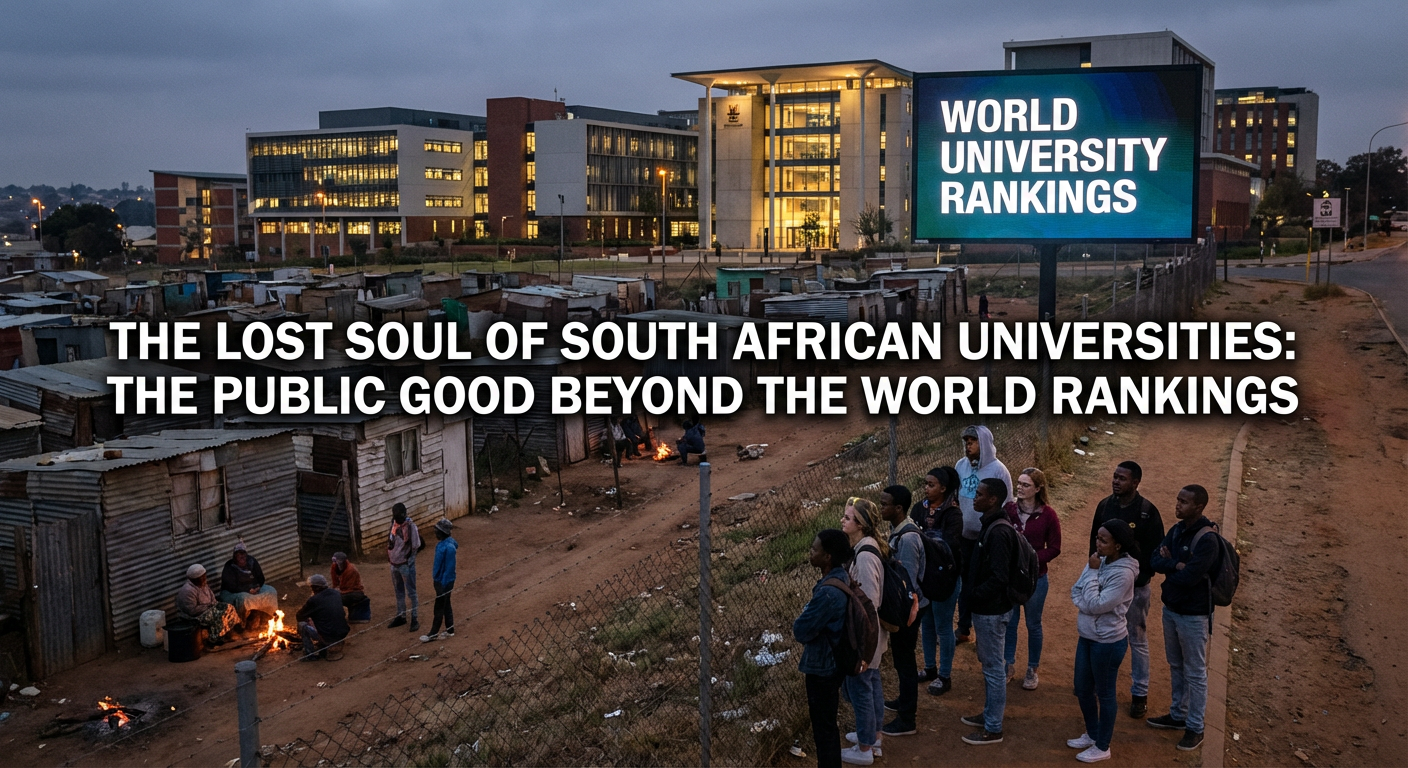
BEYOND THE WORLD RANKINGS
South African universities stand as part of the African continent’s higher education success story within the global academy. Several of our institutions host renowned scholars recognised in the Global North, as reflected in their impressive research citation indexes. Our universities feature proudly in international rankings and are celebrated as centres of excellence across the continent.
Yet, amid this success, there is little evidence that these same institutions are looking down into the valleys that surround them, valleys marked by deep and visible social distress.
Measured by the standards of world university rankings, whether from the United States, England, Hong Kong or Shanghai, our universities perform exceptionally well. However, only a few kilometres from their campuses, communities struggle with poverty, unemployment, hunger and inequality. In global rankings, our universities are highly visible. In their surrounding communities, they are often invisible.
Universities must resist the temptation to treat rankings as their primary mission. Rankings are not a mission; they are the by-product, even the “orgasm” of citation indexes. The true mission of a university, particularly in South Africa, must be the public good. Our institutions cannot afford to care only about their global positioning while remaining indifferent to the social ills that continue to devastate local communities.
Scholarship and research must speak not only to international journals, but also to street vendors in Zululand and Thohoyandou, and to communities across the country. Research must confront pressing realities: food insecurity, HIV and AIDS, tuberculosis, cholera, climate change, academic and financial exclusion, student hunger, and the painful phenomenon of access without success.
South African universities cannot be judged solely by standards set in the Global North or by the priorities of foreign sponsorships. Academic excellence that is detached from the needs and imperatives of our country becomes an unaffordable luxury. The universitas must avoid creating an artificial distance between itself and the lived realities of poor communities. It must resonate with the aspirations of the poor African child.
Promotion and recognition systems should reward not only publications in highly rated journals but also meaningful partnerships with local communities that bring about tangible transformation. Communities must not be reduced to research subjects; they must become co-creators of knowledge. The knowledge we produce must be rooted in reciprocity, dignity and shared ownership.
High-tech innovation, too, must respond to urgent local needs, whether in agricultural development, food security, renewable energy or the ocean economy. Technology that does not transform the lives of the marginalised risks becoming an abstract exercise detached from social purpose.
History will not judge our universities by their citation indexes. It will judge them by the moral choices they make. It will ask whether they chose to be present, morally and practically, in a society in distress. Vice-Chancellors and Councils carry a profound responsibility to ensure that every institutional resource is deployed in a manner that is socially responsible, ethically grounded and indispensable to community transformation.
The soul of South African universities lies not in global applause, but in their commitment to the public good.
ABOUT DR SEFOKO RAMOSHABA
Dr Sefoko Ramoshaba brings more than 30 years of professional experience, including 17 years in management positions at various South African universities: Vaal Triangle University (now Vaal University of Technology), Witwatersrand Technikon (now the University of Johannesburg), and Nelson Mandela University.
His leadership roles have included Manager and later Head of Department: Student Ethics and Judicial Services at the University of Johannesburg, and Head of Department: Student Life and Development at Nelson Mandela University. His portfolio has spanned Student Discipline, Student Ethics, Student Judicial Services, Student Development, Arts and Culture, Transformation, Social Justice, Community Engagement and Outreach Projects, and the integration of academic qualifications with community engagement as part of re-igniting transformative student life and development.
Dr Ramoshaba holds a diverse range of qualifications: a BA (English, Geography, Education and General Linguistics), a Higher Education Diploma, BA Honours in Geography, a Diploma in Criminal Justice and Forensic Auditing, an ND in Law, BA Honours and an MA in Public Management and Development, and a PhD in Public Management and Development from the University of Johannesburg. He also completed the Leadership Enhancement Programme (LEAP) at Nelson Mandela University.
He has published more than eight academic works and is a committed proponent of social justice, community empowerment and civic engagement. He serves as a Faculty Member of the WorldWide Institute for Leadership and Development (WILD) and remains deeply committed to advancing the legacy of people-centred and community-driven transformation.


